
Our School
The push for preschool education is gaining momentum in India. More and more parents are aware of the young preschool phase being an impressionable age. The fundamental learning that happens at this stage is one that cannot be acquired in the later years. Also with more and more families having both parents working, there is a need for the school to be a second home where the child gets plenty of attention, love ,sense of belonging and a feeling of security.
This school will serve as a congenial environment, a second home where the child will receive love, care and guidance of a teacher, considerable freedom to play and develop at his own pace, and evolve his social skills. The child learns through play and more importantly works on all round development in a manner that sustains the interest of the child, challenging him to do more ,thus giving him a sense of achievement to therefore build self-confidence.
Main Goal
TrottersStop Montessori School takes a whole-child approach to preschool education. Teachers and support staff work together to meet the intellectual, sensorial,social, behavioral, and emotional needs of each and every child we serve.Its a hands on approach which is multi-sensory and children learn concepts by working with their hands and senses .
• Children learn to settle into the environment by carrying out the simple everyday chores(cutting vegetables,sweeping,dusting) (Exercises of Practical Life), which they are already familiar with.
They then go onto becoming conscious of the physical properties of matter like dimensions ,colour, texture ,shapes sizes using the various appropriate senses and suitably designed scientific sensorial materials to then be able to classify and label the same without deliberately doing so. • The children are introduced to numbers with materials that evoke the curiosity in the child and allow hands on experience, with the fundamental principles in Math and also the Decimal system of numeration unveiling as they work with it.
• Phonetics is the method that introduces the child to the world of sounds and children learn to associate these zoo-phonic sounds for the symbols(letters of the alphabet). In no time they start reading combining both phonetic and non phonetically sounded words with writing being introduced systematically and effortlessly .
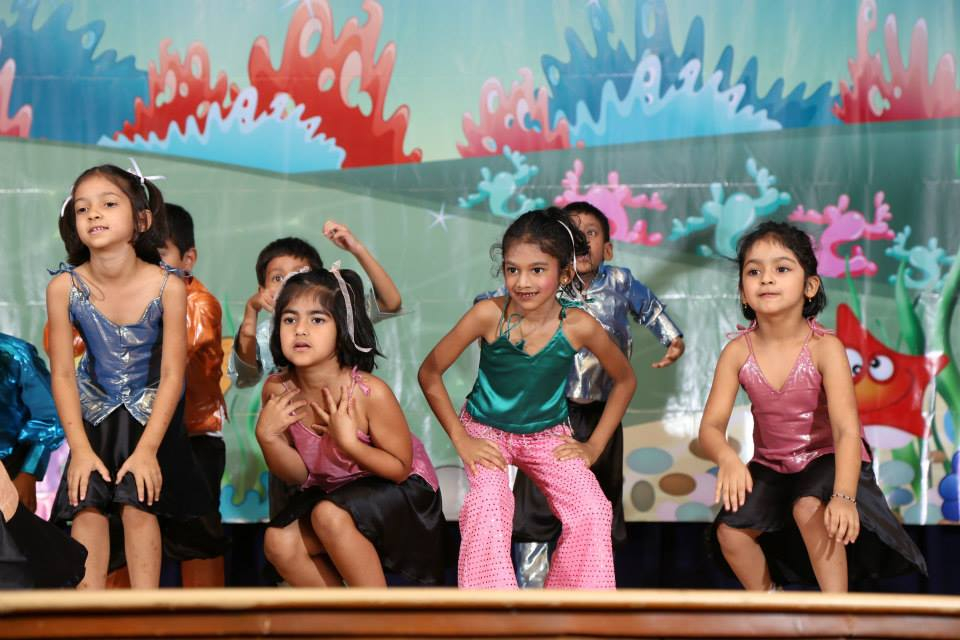
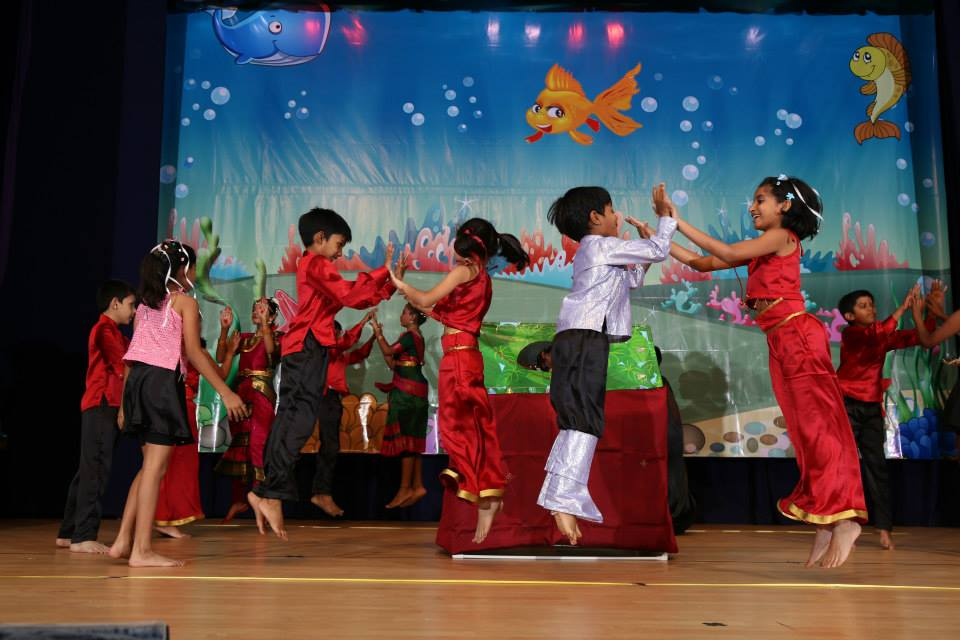
• The system offers unique opportunities for the child to be exposed to the world of art, music , drama through rhymes and story-telling,dramatization where the child participates and paints the picture of the world he knows and is still learning.
• The children also get a chance to exercise their imagination and creativity through art and creative activities . Outdoor activities are encouraged and children get a chance to refine their gross and finer motor coordination skills.
Montessori Concept
In the Montessori classroom, learning materials are arranged invitingly on low, open shelves. Children may choose whatever materials they would like to use and may work for as long as the material holds their interest, to then go and put back the material presented to them back to where it belongs. The materials themselves invite activity. There are bright arrays of solid geometric forms, knobbed puzzle maps, coloured beads, and various mathematical tools which are both scientific and precise.
Each material in a Montessori classroom isolates one quality. In this way, the concept that the child is to discover is isolated. For example, the material known as the pink tower is made up of ten pink cubes of varying sizes. The child constructs a tower with the largest cube on the bottom and the smallest on top. This material isolates the concept of size. The cubes are all the same colour and texture; the only difference is their size. Other materials isolate different concepts: colour tablets for colour, geometry materials for form, and so on.
this school foloows a theme based curriculum and enrichment of experiences in as many different ways so that the multiple impressions made through these enriching experiences makes the child want to remember the learning done as it was not just interesting, but totally an enjoyable experience .This then tempts the child to want to come back to knwing and learning more .
What sets us apart is our unique curriculum, small student teacher ratio, personalised attention and care of each individuals unique learning pathway, keeping in mind the standardised banchmark of milestones needed to be crossed. Most importantly a nurturing, loving and selfless effort to genuinely make the child make an impression on learning and a fondness to the journey of going forward to believing in himself and setting sail to reach the horizon through a fun and adventurous pathway of learning.